
From sequence-defined RNA strands to programmable, multifunctional nanoparticles
RNA is more than a therapeutic cargo. It can also be the material that builds the delivery system.
Our platform combines chemical RNA synthesis, site-specific modification, purification, conjugation, self-assembly, and nanoparticle quality control in one connected workflow. The result is a modular system in which structure, targeting, imaging, and therapeutic function can be designed together from the beginning.
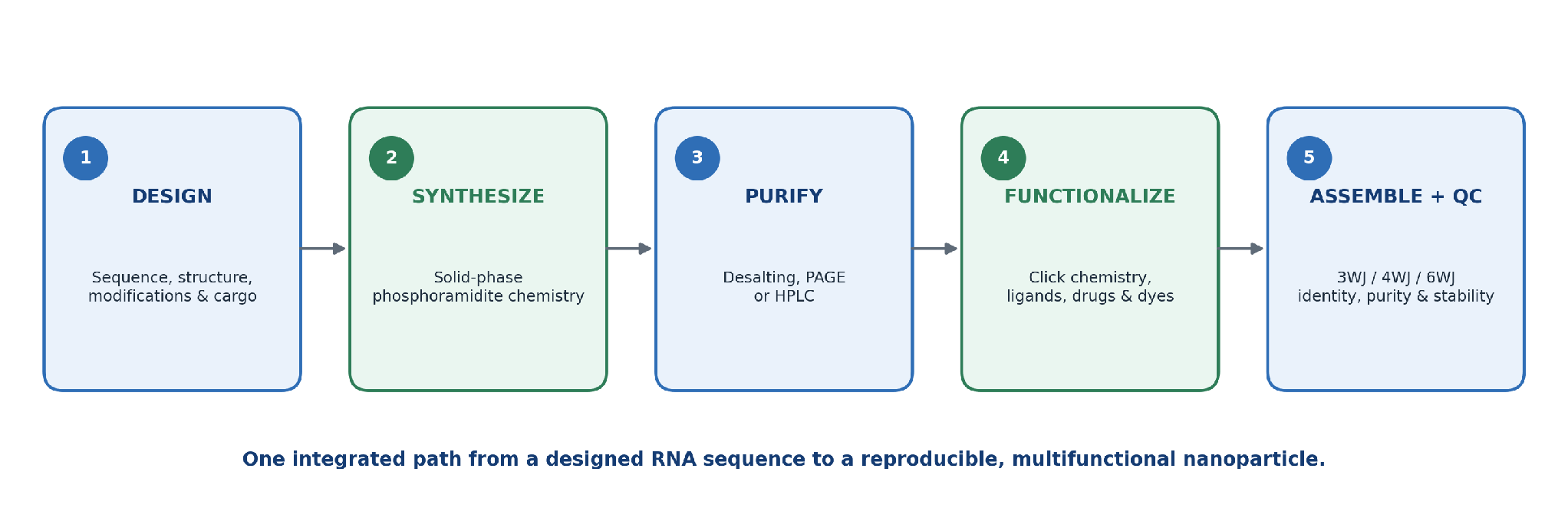
Fundamental Concepts
Explore RNA & Nanoparticles
What Is RNA?
RNA, or ribonucleic acid, is a biological molecule made from four nucleotide building blocks: adenine, uracil, guanine, and cytosine. It is usually single-stranded. However, parts of the strand can pair with one another and fold into helices, loops, junctions, and other three-dimensional structures. RNA contains a 2′ hydroxyl group that makes it chemically different from DNA and more sensitive to degradation.
RNA does more than carry genetic information from DNA. It can regulate genes, recognize proteins and cells, bind complementary nucleic acids, and in some cases catalyze reactions. Because its sequence determines both its structure and function, RNA can be programmed as a therapeutic molecule, targeting element, sensor, or building material for nanoparticles.
Our Custom and Modified RNA
We prepare sequence-defined RNA strands using solid-phase phosphoramidite chemistry. This approach allows nucleotides and chemical functionalities to be placed at specific positions within the RNA:
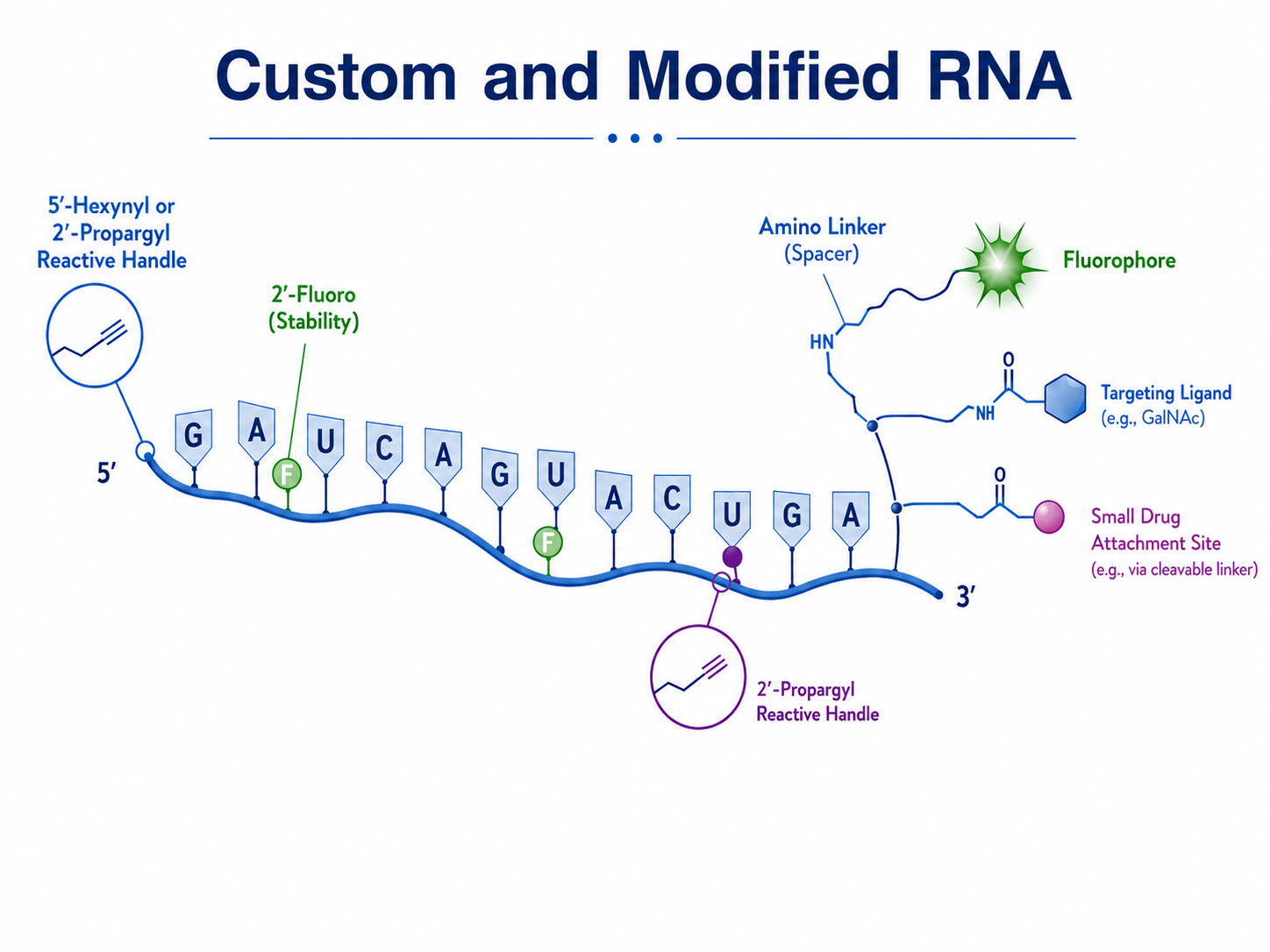
Automated solid-phase synthesis enables single-nucleotide precision
Integrated Production Workflow
Key Features of Our Synthetic RNA & Nanoparticle Platform
Our integrated production platform combines sequence and architecture design, automated solid-phase RNA synthesis, site-specific chemical modification, purification, conjugation, and controlled self-assembly to generate defined RNA strands and multifunctional RNA nanoparticles.
Sequence-Guided RNA and Nanoparticle Design
Each project begins with the required biological function and the final molecular format. RNA length, junction geometry, complementary regions, modification sites, targeting modules, and therapeutic cargo are considered together. This approach helps ensure that each strand can be synthesized efficiently and can still fold or assemble correctly after modification.
Automated Solid-Phase RNA Synthesis
RNA strands are prepared by phosphoramidite chemistry on a solid support. The synthesizer adds nucleotides one at a time through repeated detritylation, coupling, capping, and oxidation steps. This method provides direct control over sequence composition and is well suited for short to medium-length RNAs that require defined chemical modifications.
Site-Specific Chemical Modification
Natural nucleotides can be combined with modified building blocks during synthesis. Options include 2′-fluoro nucleotides for improved nuclease resistance, 2′-propargyl or 5′-hexynyl groups for click chemistry, and terminal amino or linker groups for further conjugation. Aptamer, siRNA, antisense, or other functional sequences can also be incorporated into the strand design.
Controlled Cleavage, Deprotection, and Purification
After synthesis, the RNA is cleaved from the support and base-protecting groups are removed under controlled conditions. RNA-specific 2′-O protecting groups are then removed before desalting and final purification. PAGE, reverse-phase HPLC, anion-exchange HPLC, or other methods can be selected according to strand length, charge, hydrophobicity, and modification pattern.
Drug, Ligand, and Fluorophore Conjugation
Alkyne-modified RNA can be joined to azide-bearing linkers through click chemistry. The linker can then connect the RNA to a drug, fluorophore, or targeting ligand. Ester linkages may be used when enzymatic payload release is desired, while more stable linkages can be selected when the attached component should remain connected during the experiment.
Programmable RNA Nanoparticle Assembly
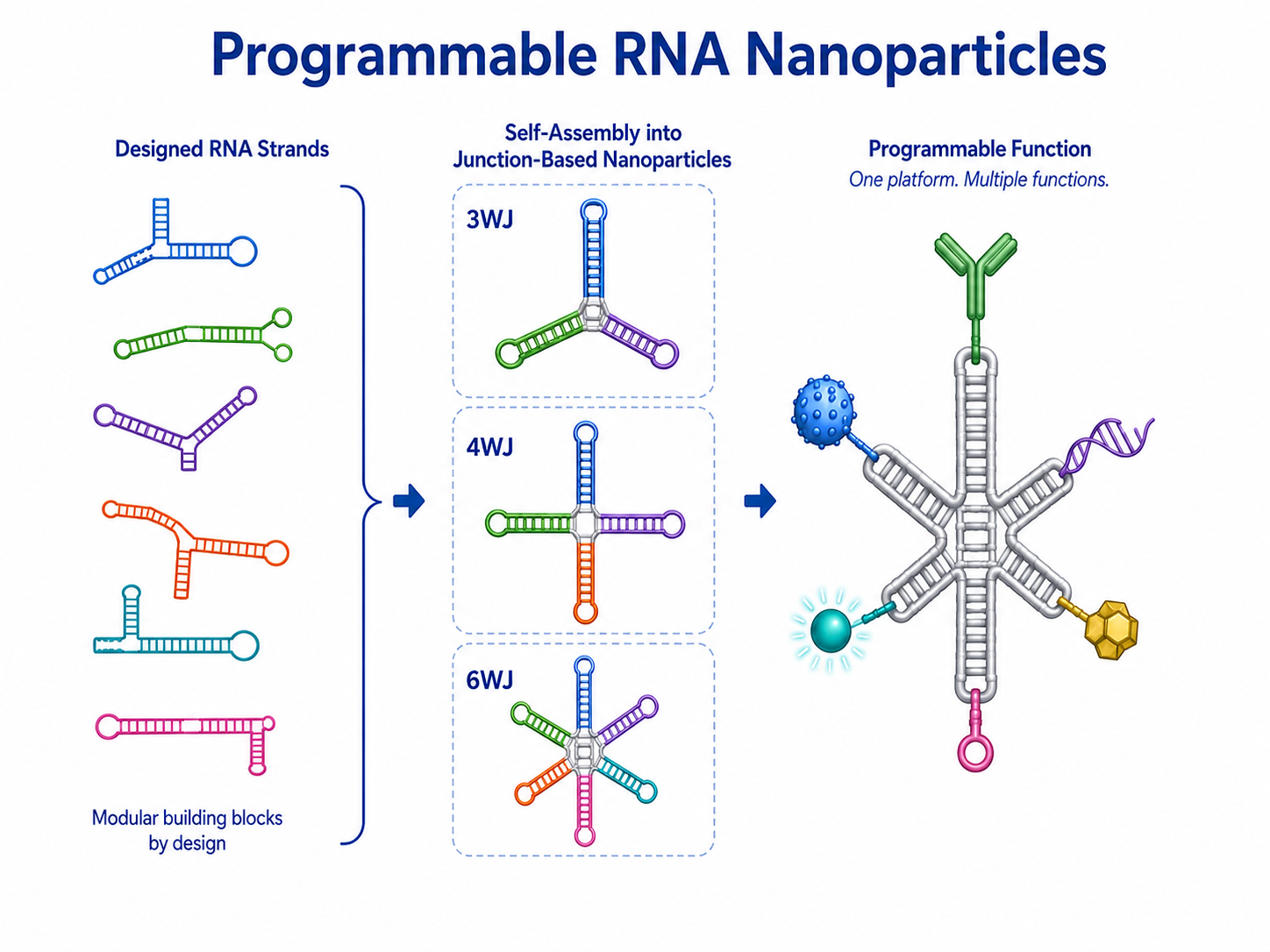
Purified strands are combined at defined ratios and annealed into the intended structure. The platform supports three-way, four-way, and six-way junction architectures, as well as other complementary RNA assemblies. Separate branches can be assigned to targeting, imaging, gene regulation, or drug delivery without requiring a separate carrier material.
Comprehensive Quality Assessment
Individual strands can be evaluated for purity, identity, concentration, and conjugation efficiency. The assembled nanoparticle can then be examined for complete assembly, homogeneity, aggregation, thermal stability, and functional activity. Analytical methods are selected according to the product and may include PAGE, HPLC, mass analysis, size-exclusion methods, DLS, or application-specific assays.
Explore In-Depth Platforms
Dedicated RNA Technology Sub-Platforms
Integrated RNA Preparation Platform
8-stage solid-phase chemical RNA synthesis, purification strategies (PAGE, RP-HPLC, AX-HPLC), small-molecule click conjugation, and post-purification QC.
Synthetic RNA Nanoparticle Platform
Programmable 3WJ, 4WJ, and 6WJ architectures, multi-junction self-assembly protocols, published preclinical proof points, and multivalent payload delivery.