Integrated RNA Preparation Platform
Automated solid-phase phosphoramidite chemistry, site-specific modifications, bioorthogonal click conjugation, and application-specific purification for research-ready oligonucleotides and nanoparticle components.
How Chemically Synthesized RNA Is Made
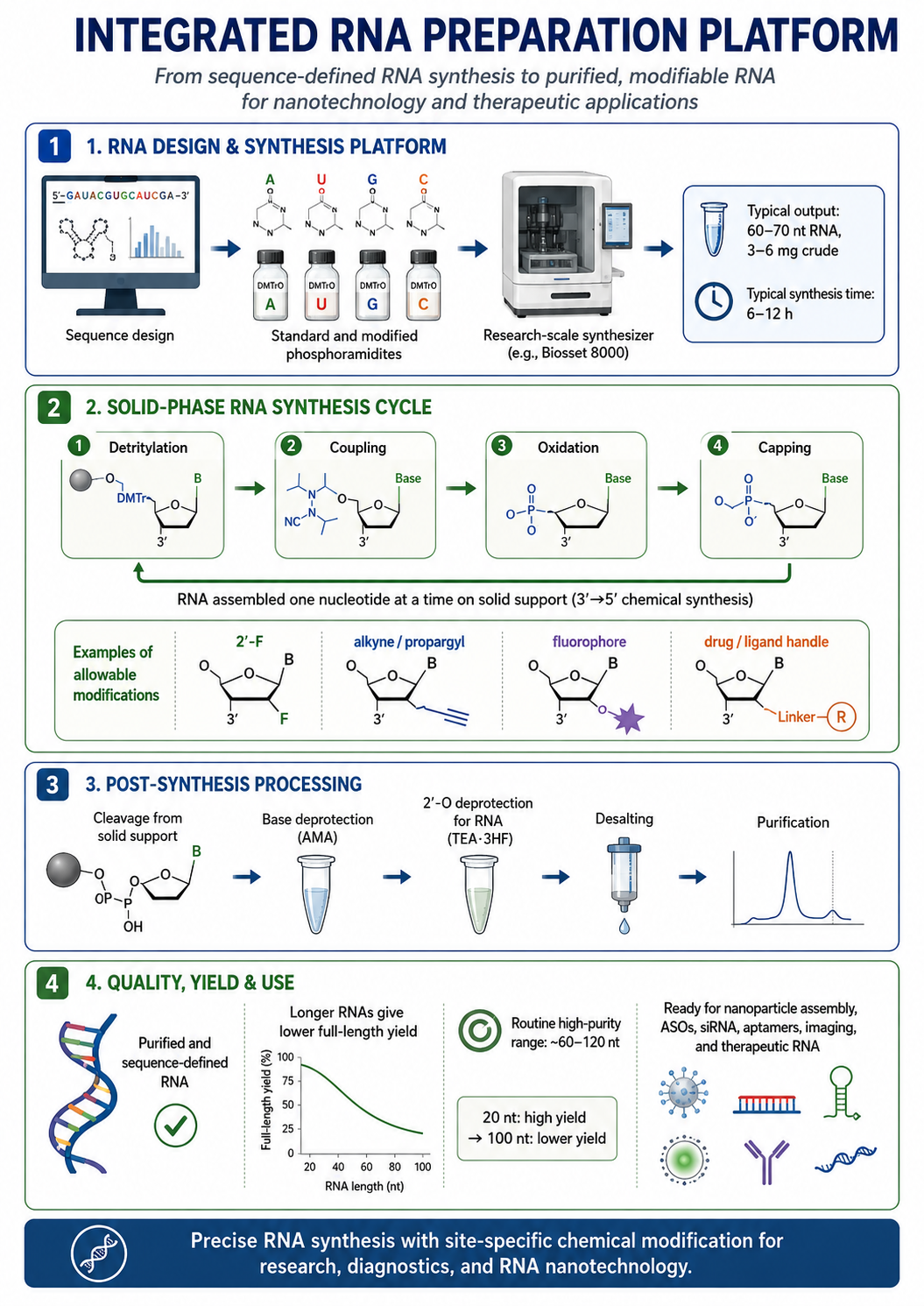
Chemical RNA synthesis builds a strand one nucleotide at a time on a solid support. Each incoming nucleotide is temporarily protected so it reacts only at the intended position. The synthesizer repeats a controlled cycle of deprotection, coupling, capping, and oxidation until the full sequence is complete.
The value of this approach is precision. Natural and modified nucleotides can be placed at selected positions, making it possible to introduce nuclease-resistant sugars, alkyne handles, amino groups, fluorophores, targeting modules, and drug-linker attachment sites directly into the strand design.
Why Strand Length Matters
No coupling step is perfectly efficient. Small losses accumulate as the strand grows, so longer and heavily modified RNAs usually need more process optimization and stronger purification than shorter strands. The synthesis strategy is therefore designed around sequence length, modification density, and the intended downstream use.
Step-By-Step Process
Stages of RNA Synthesis
From sequence design to final desalting and chromatographic polishing.
Sequence and construct design
We begin with the final biological job: structural assembly, targeting, gene regulation, imaging, drug delivery, or a combination of these. The sequence, predicted folding, strand length, modification sites, complementary regions, and purification strategy are planned together.
Initiation on solid support
The first nucleoside is attached through its 3′ end to a controlled solid support. Its 5′ hydroxyl remains protected until the next nucleotide is ready to be added.
Detritylation and activation
The temporary 5′-DMT protecting group is removed, exposing the reactive hydroxyl. The selected phosphoramidite is then activated for coupling.
Coupling
The incoming nucleotide reacts with the support-bound strand and extends it by one base. This is the key sequence-building step and is optimized for the selected monomer and modification.
Capping and oxidation
Unreacted strands are capped so they cannot continue growing as deletion products. The new phosphorus linkage is then oxidized into a stable phosphate form. The cycle repeats until the sequence is finished.
Cleavage and base deprotection
The completed RNA is released from the support, and protecting groups on the nucleobases and backbone are removed under controlled conditions.
2′-O deprotection
RNA requires an additional deprotection step at the ribose 2′ position. Conditions are selected to remove these groups while protecting strand integrity.
Desalting and purification
Residual salts, solvents, shortened strands, and chemical by-products are removed. The purification method is matched to the RNA’s length, charge, hydrophobicity, and modification pattern.
Building Function into Every Strand
The chemistry is selected around the job of the final particle. A targeting module must remain exposed. A drug may need to be released after uptake. A fluorophore may need a stable bond. A gene-regulating strand must remain accessible to the cellular machinery. These requirements are considered before synthesis, not added as an afterthought.
| Modification Class | Examples | Why It Is Used |
|---|---|---|
| Stability chemistry | 2′-fluoro and other ribose/backbone modifications | Increase resistance to nucleases while preserving the required fold and base pairing. |
| Reactive handles | 5′-hexynyl, 2′-propargyl, amino linkers | Create defined attachment sites for drugs, fluorophores, ligands, peptides, or other modules. |
| Targeting modules | Aptamers, GalNAc/hepatocyte ligands, folate, receptor-binding ligands | Promote receptor recognition, multivalent binding, and cell-selective uptake. |
| Therapeutic RNA | siRNA, anti-miRNA, miRNA, antisense sequences | Regulate gene expression or restore/suppress biological pathways. |
| Nucleotide analogues | FUdR and gemcitabine-related building blocks | Create RNA-based constructs that combine structural assembly with anticancer nucleotide chemistry. |
| Imaging and detection | Fluorophores, radiolabel-ready handles, fluorogenic aptamers | Support binding studies, tracking, imaging, biodistribution, and diagnostic development. |