
Soluble Protein Technology
Construct optimization, multi-host expression screening (bacterial, insect, mammalian), multi-step FPLC purification, and rigorous biophysical quality assessment for research, structural biology, and assay development.
How Soluble Proteins Are Made
A gene encoding the target protein is placed into an expression vector and introduced into a suitable host. The host cell reads the recombinant gene and produces the protein. The product is then recovered from the culture medium or from lysed cells, depending on whether it is secreted or retained inside the cell. Purification normally begins with selective capture and continues through one or more polishing steps.
Why Expression Host Selection Matters
E. coli can provide rapid and economical production for many relatively simple proteins. Sf9 insect cells support more complex folding and some post-translational processing. Expi293F mammalian cells are useful when human-like folding, secretion, glycosylation, or other mammalian processing is important. The host is chosen according to protein complexity and downstream use.
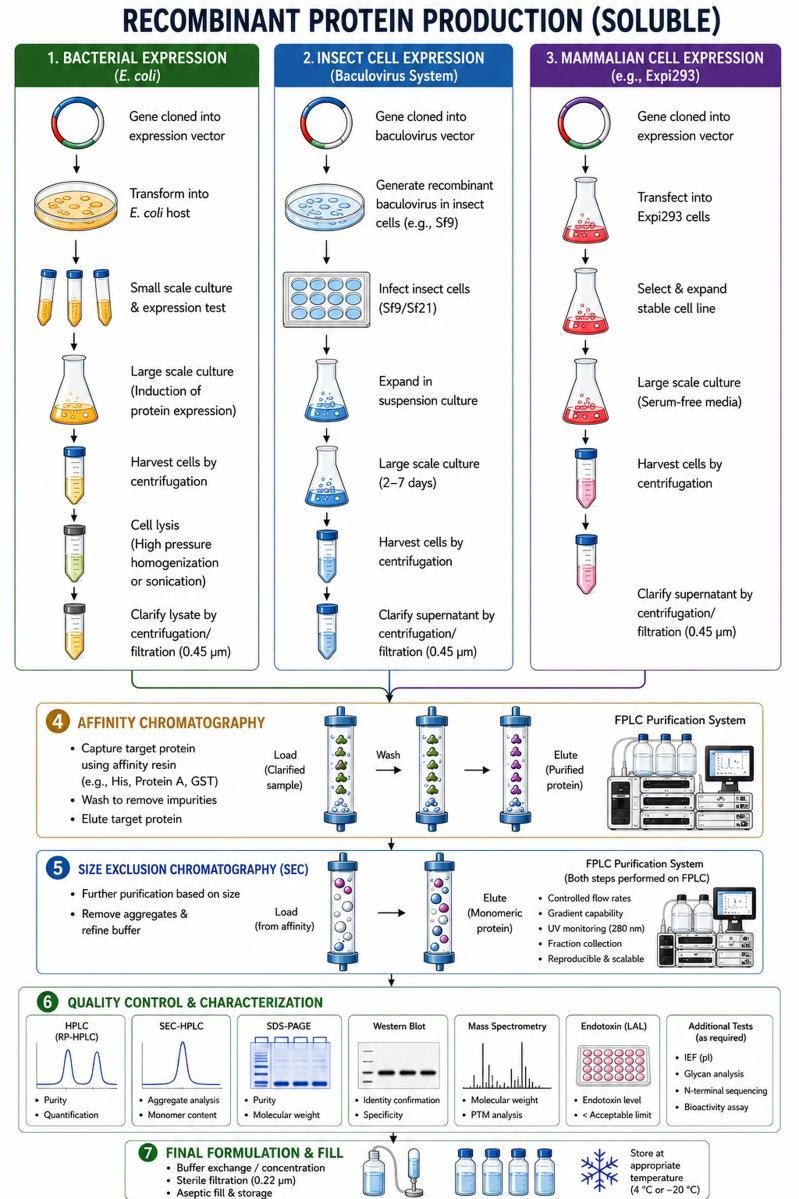
End-to-End Pipeline
Stages of Soluble Protein Production
From gene synthesis and construct design to multi-modal chromatographic polishing.
Target and construct design
The sequence is reviewed for domain boundaries, signal peptides, transmembrane regions, disordered segments, cleavage sites, oligomerization domains, and purification tags. Several constructs may be designed when the optimal boundaries are uncertain.
Expression-system selection
E. coli, Sf9, or Expi293F is selected according to folding complexity, solubility, secretion, post-translational modification requirements, desired scale, and the final assay.
Small-scale expression screening
Candidate constructs are tested before scale-up. Expression level, solubility, secretion, culture conditions, induction parameters, and initial product quality are compared to identify the most promising route.
Scale-up and culture
The selected construct and host are expanded under controlled culture conditions. Cell density, temperature, induction or infection conditions, harvest time, and media composition are adjusted to improve yield and reproducibility.
Harvest and product recovery
Secreted proteins are recovered from clarified culture medium. Intracellular proteins are obtained by cell harvest, controlled lysis, and separation of soluble material from insoluble debris.
Clarification and initial capture
Centrifugation and filtration remove cells and particulates. Affinity chromatography can then selectively capture a tagged or naturally binding target from the clarified feed.
FPLC purification and polishing
Ion-exchange chromatography can separate charge variants and residual contaminants. Size-exclusion chromatography removes aggregates and separates protein populations according to hydrodynamic size.
Buffer exchange, formulation, and QC
The purified protein is transferred into an application-appropriate buffer and concentrated carefully. Identity, purity, monodispersity, stability, concentration, and biological activity are evaluated before final delivery.
From Purified Protein to an Application-Ready Preparation
Purification is not complete when the final chromatography peak is collected. The protein must be placed into a buffer that supports its intended concentration, handling, storage, and assay conditions without causing precipitation, aggregation, or loss of activity.
Expression Hosts
Our Expression Platforms
Matched to molecular complexity, folding requirements, and application goals.
E. coli
Rapid Bacterial Expression
Useful for many non-glycosylated proteins, enzymes, domains, antigens, and screening constructs. Supports fast iteration and straightforward scale-up.
Sf9 Baculovirus
Baculovirus-Insect Expression
Supports proteins that are difficult to fold in bacteria and provides eukaryotic processing. Ideal for structural and functional proteins requiring a eukaryotic host.
Expi293F
High-Yield Mammalian Expression
Supports human-like folding, secretion, glycosylation, and assembly for complex recombinant proteins, receptors, extracellular domains, and antibodies.
Building Performance into Every Protein
Protein performance is shaped by construct design, host selection, purification process, and final formulation. These variables are planned together so that yield improvements do not come at the expense of folding, homogeneity, or activity.
Capture Strategy
Affinity tags or natural binding interactions provide strong selectivity, rapidly enriching the target from clarified feed.
Polishing Workflows
Ion-exchange and size-exclusion chromatography resolve contaminants, charge variants, and aggregates.
Formulation Screening
Transferred into formulation buffers compatible with planned assay conditions, concentration, and long-term storage.